What Quantum Computing Actually Is
A short introduction to quantum computing, and what a few years of courses taught me.
A regular bit is 0 or 1. A qubit can be both at once, until you check it. That is the one-line version everyone gives. This post is the part after that line.
I spent parts of the last few years in quantum computing courses: one in 2021, one in 2023, a seminar at CQuERE, and one in 2025 run by IIT Roorkee and C-DAC. My notes and notebooks sit on GitHub.
How a normal computer works
Every computer runs on electricity passing through tiny switches called transistors. Each switch is on or off. On and off is a bit: 1 or 0. Your phone, your laptop, every server on the internet, all of it is billions of these switches flipping fast enough to feel instant. That is classical computing.
Quantum computing does not replace this. It adds a new kind of switch, made from things like electrons or photons, that can hold something a regular switch cannot.
A qubit is not a spinning coin
People picture a qubit like a coin mid-flip, already heads or tails, you just have not looked. That feels right. It is wrong.
A qubit in superposition has no hidden answer inside it. It is undecided until measured. Physicists confirmed this with Bell's experiments: the results only make sense if there is no hidden answer at all. The uncertainty is real, not a secret you have not found yet.
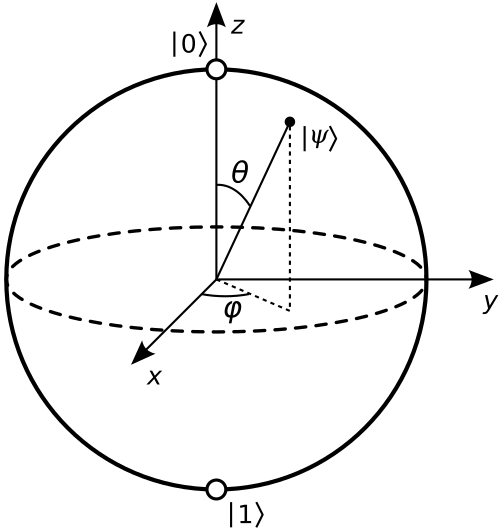
Undecided — click to measure it.
Quantum computing's "hello world"
Now that you know what a qubit actually is, here is the smallest real program, in Qiskit:
qc = QuantumCircuit(1, 1)
qc.h(0)        # puts the qubit into a 50/50 state
qc.measure(0, 0)
run(qc, shots=100)
One qubit, one gate, one measurement, run 100 times. There is no print.
One run gives you a single 0 or 1, which tells you nothing. The real
answer only appears after running it many times and counting the results.
One qubit, one gate, measured 100 times. Run it.
Run it and you get close to half 0s and half 1s, every time. That split is the actual output of this program. It proves the gate did its job: if the qubit were not truly 50/50, the results would lean to one side instead of splitting evenly.
Entangled qubits do not send messages
Another myth: two entangled particles talk to each other instantly, even across the galaxy.
They do not talk. Measure one and you instantly know something about the other, however far apart they are. But the result is random. You cannot control it, so you cannot send a message with it. The only way to see the connection is to compare notes afterward, the slow ordinary way. Nothing here goes faster than light. It is a correlation, not a phone call.
Click to measure both at once.
Quantum gates, and why they must be reversible
Past those two ideas, the real work is quantum gates: small operations that rotate a qubit's state, the quantum version of AND, OR, NOT.
One rule sets them apart: almost all must be reversible. Run one backward and you get your input back exactly. A regular computer throws information away constantly. A quantum computer cannot, because its physics will not allow it.
Run it twice and you are back where you started. Every step has a way back, nothing was thrown away.
Algorithms like Grover's search and Shor's factoring are built from chains of these gates. Wrong answers cancel out, the right answer grows louder. That is the real source of the speedup, not "checking every answer at once."
What the machine actually looks like
All of this, superposition, gates, interference, is the theory. The hard part is holding a qubit still enough to use it at all.
Most quantum computers today use loops of superconducting metal as qubits, cooled to near absolute zero, colder than deep space. At that temperature electrical resistance disappears, and the loop can hold its state for a moment without the outside world disturbing it. That is why a quantum computer looks like a giant gold chandelier: that shape is the refrigerator, and almost all of it exists just to keep one small chip at the bottom cold enough to work.
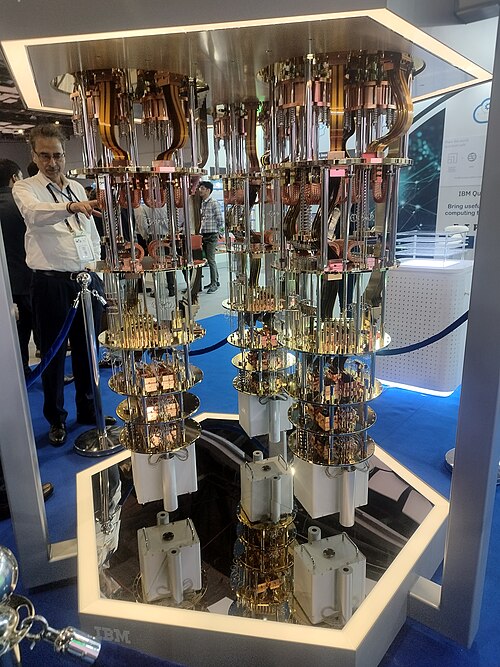
Qubit counts get quoted like a spec sheet, but more qubits alone is not more power. IBM's Condor hit 1,121 qubits as a scaling test. Google's Willow runs only 105, but proved errors go down as qubits go up, the harder problem. Qubits lose their state within microseconds, called decoherence, and most of the engineering here is about fighting that, not raising the count.
If you are starting out
The algorithms made sense once the linear algebra under them, vectors and matrices, stopped being new.
A real simulator helps too. Reading that a qubit flips between 0 and 1 is abstract. Watching it happen on Qiskit or PennyLane, again and again, makes it real.
I am still learning this myself. The notes are public and unfinished. That is what an honest working notebook looks like.
Resources
- My notes and notebooks from all these courses
- Qiskit, IBM's quantum simulator and SDK
- PennyLane, a simulator built for quantum machine learning
- National Quantum Mission, the government program behind India's quantum push
- IIT Roorkee and C-DAC's quantum computing course, the one I took in 2025