Microsoft Learn Student Ambassador (2023)Archived
I heard the term MLSA at a Google event, applied, and got in. Two years of teaching Microsoft technologies, and one thing about the programme that made me leave it.
I first heard the word MLSA at a Google event.
Google I/O Extended in Bengaluru, May 2023. Jeevan said he was an MLSA and I nodded like I knew what that meant. I did not. Microsoft Learn Student Ambassador, it turned out, and going home that night it was one of two things I had actually come away with.
Applying
The shape of it: you come on board as a student ambassador, you get access to Microsoft's resources, and in exchange you teach Microsoft technologies to other students.
I was already teaching free material to whoever wanted it. This was the same thing with a programme around it, so applying was easy to decide.
There was an interview. It went well, I gave a good read of it, and a couple of weeks later the mail came.
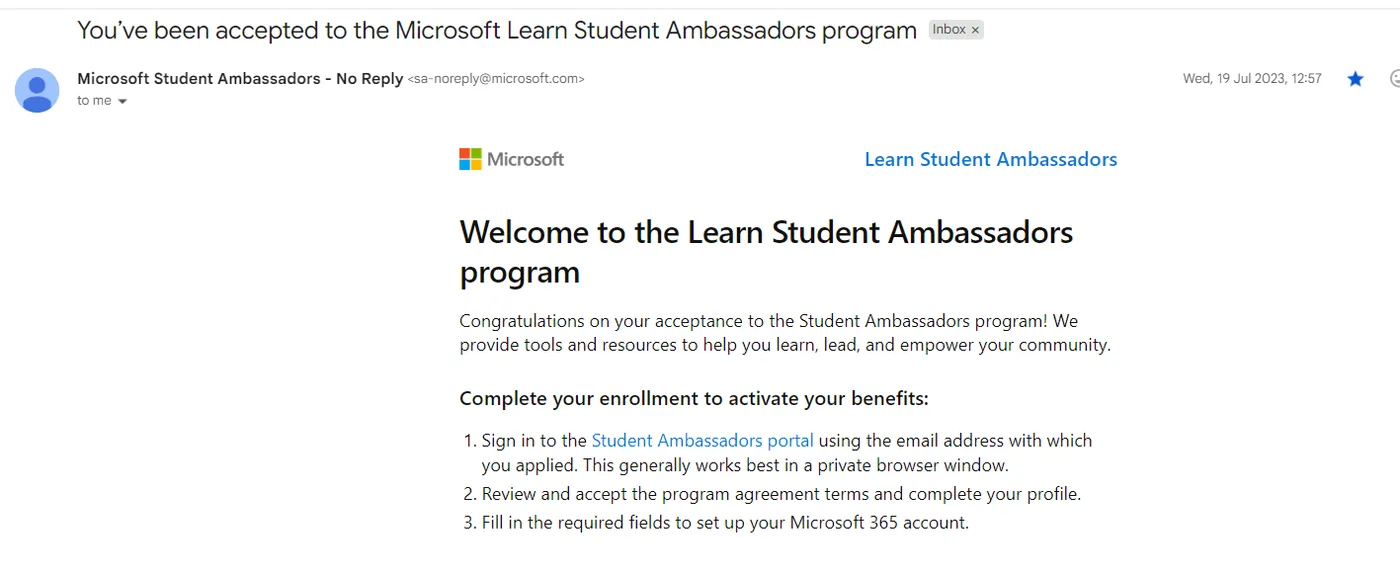
Alpha to Beta
The programme has levels, and I went from Alpha to Beta.
What that looked like day to day was speaking. Sessions inside my college, sessions outside it, and sessions online through our own platforms. The subject was whatever I was learning at the time, which is how I ended up properly inside Azure, GitHub, Microsoft DevOps, and a lot of the surrounding tooling.
There was a global community behind it, ambassadors from a lot of countries in one group, and Microsoft ran sessions where people from the company would join a call and teach. Not marketing calls, actual technical ones.
The support around the teaching was good too. Mailing lists, Teams channels, a GitHub tool that generates certificates so you can send participants something after a session, exam vouchers, course access.
The part that went wrong
Microsoft launched it for an obvious and legitimate reason. They want students using their technologies, and students want to learn them. That trade is fine.
To make it work they gave ambassadors things. Goodies, watches, LinkedIn Premium, product keys, Azure credits. Real value, handed out for teaching.
Some people started selling it.That is the whole problem in one sentence. The rewards existed to make teaching worth someone's time, and once there was a resale market they became the point. The programme started tilting toward a business happening inside it rather than the learning objective it was built for.
It stopped being about who could teach and started being about who could collect.
I stopped involving myself after that.
Leaving
My graduation was ending anyway. I became an MLSA in 2023, graduated at the end of 2024, and the position does not survive graduation, so it was going to end regardless. I left it earlier than I had to.
Microsoft did eventually strip out most of what had turned it into a market. That was the right call and it says something that they made it.
What I take from it
Two years of a reason to teach, a lot of Azure and GitHub and DevOps I would not otherwise have learned properly, and a global community that was genuinely worth being in.
And one lesson that has nothing to do with Microsoft: the moment you attach something valuable to a behaviour, some people will optimise for the reward instead of the behaviour. That is not a flaw in the people who ran it. It is what incentives do, and it is worth designing against from the start.